
GAME CONCEPTS: ADVANTAGE & DISADVANTAGE

Advantage (left) and Disadvantage (right) are fundamental game concepts which apply to Attacks as well as Skill Checks.
Early on in development, it was decided that modifying dice rolls with numerical bonuses and penalties could become overly complex and math-y. Once the to-hit numbers for weapons became standardized as flat values, however, there still needed to be a way to give bonuses and penalties based on things like unit movement, high ground, and various possible unit “buffs”.
The solution was as simple as a binary ADVANTAGE and DISADVANTAGE. Whenever a unit is performing an Attack or a Skill Check, various circumstances give them sources of Advantage/Disadvantage. Advantages cancel out Disadvantages and vice versa, creating a net result of either Advantage or Disadvantage on a roll (or obviously neither if they perfectly cancel one-another out or if there are no sources of Advantage or Disadvantage in this particular instance).
After experimenting with various options for what the actual benefit of Advantage might be, it was decided that Advantage should allow a player to re-roll any or ALL of the dice involved in an Attack/Skill Check. Disadvantage, conversely, would allow the player’s opponent to force a re-roll of the dice of their own choosing. If this sounds like a very extreme effect, it is! But it’s also tempered by the fact that it creates more reliable results rather than necessarily swinging the overall possible damage of an attack significantly. For example, a unit like the Buffalo Soldier is rolling 3 dice and hitting on 5 or less at medium range expects to score roughly 1.8 successes every time they roll. If they were to obtain Advantage on this roll, their success rate goes up to 2.52 (a 40% increase). Disadvantage, conversely brings the average success rate down to 1.08.
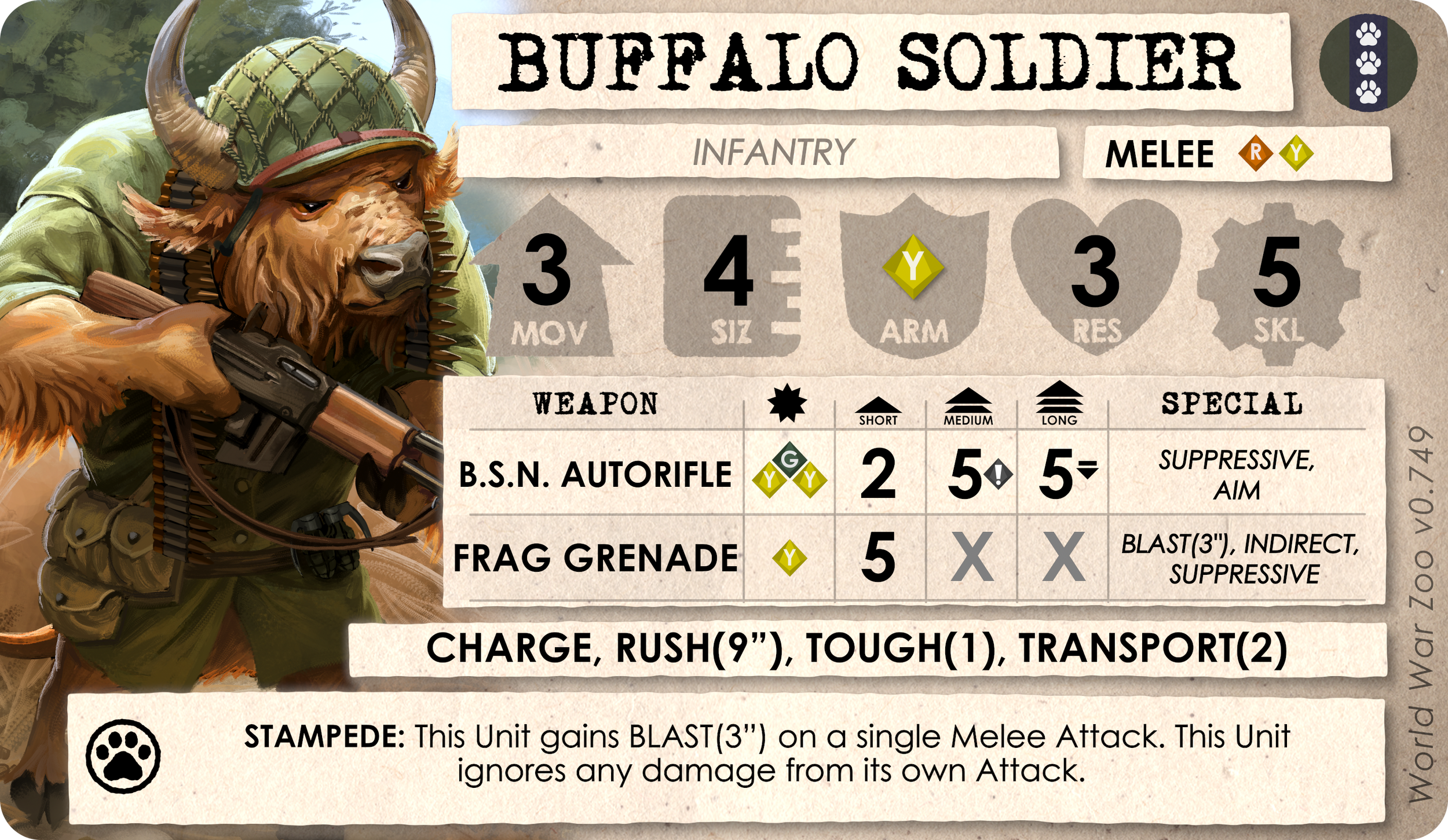
The Buffalo Soldier’s “B.S.N. Autorifle” has Disadvantage in the Long Range band, but a source of Advantage could cancel it out.
MULTI-ADVANTAGE/DISADVANTAGE
MULTI-ADVANTAGE and MULTI-DISADVANTAGE, as their names imply, refer to situations where the net Advantage/Disadvantage is greater than ONE after all sources are accounted for. While we originally didn’t want to have to create a second level of effect, it turns out that Disadvantage on its own didn’t always have quite a severe enough penalty to make the probability of success low. Multi-Disadvantage requires that the Attacker remove half of the dice of their choice from the attack, rounded down, but they are required to remove a minimum of one die (meaning single-die attacks with Multi-Disadvantage are cancelled). Then, the Attacks still has Disadvantage, and their opponent may still force them to re-roll as desired. This makes heavily Disadvantaged attacks hard to pull off and also ensures that weapons which roll a lot of dice are adequately reduced in effectiveness.
Multi-Advantage doesn’t have quite as extreme an upside - with the aforementioned reasoning that swinging overall damage potential beyond what is typical with a weapon should be rare. The unit possessing the Multi-Advantage always adds a single Yellow Die (+1YD) to their roll. That die can then be re-rolled along with the rest as desired from having Advantage. This increases the possible damage a bit without making it too extreme, and it tends to disproportionately benefit weapons with a lower number of attacks in the same way that Multi-Disadvantage penalizes weapons with higher numbers of attacks.
Using the same Buffalo Soldier from the previous example, a Multi-Disadvantage attack would reduce the average number of successes to 0.72, while a Multi-Advantage situation would increase the number of success to 3.36.
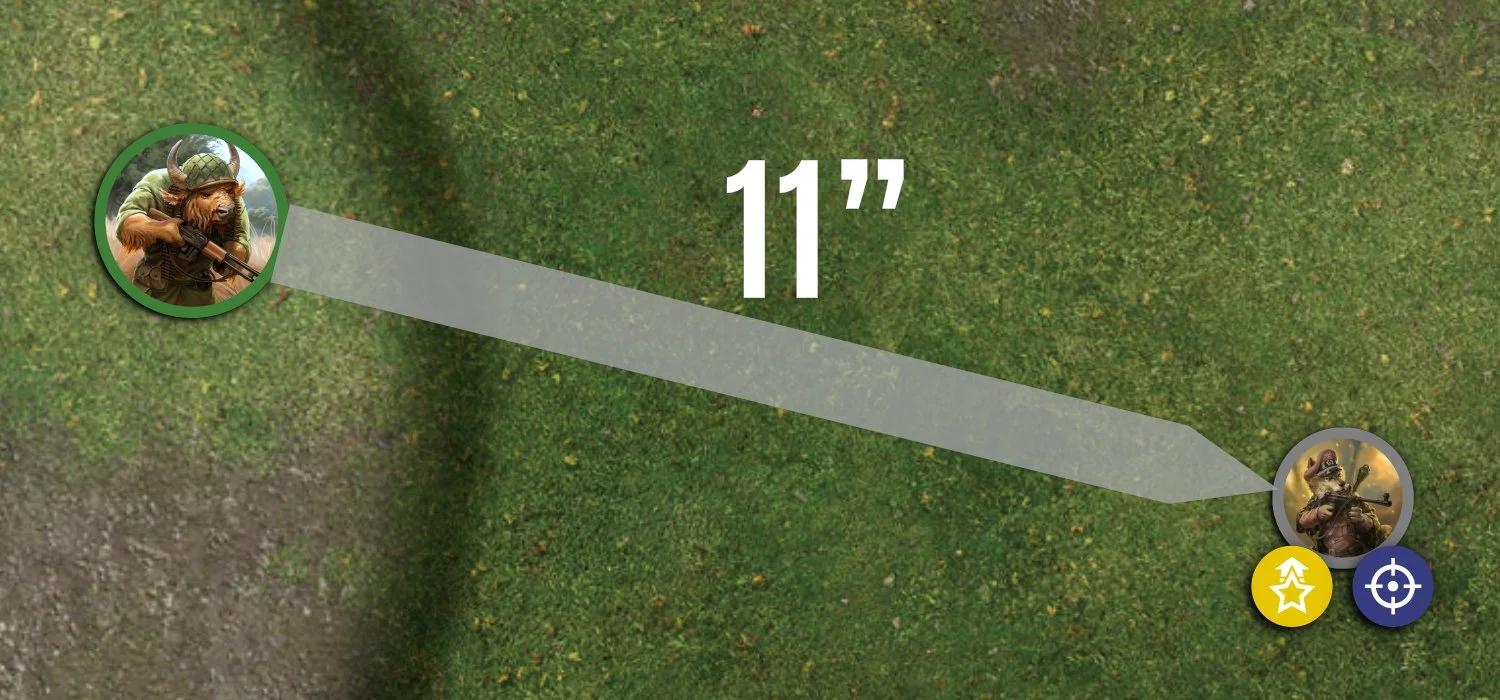
In this image, a Buffalo Soldier targets the Wolf Waffen with a Shooting Attack from its “B.S.N. Autorifle” in the medium range band. The Buffalo is on Elevated Terrain (Advantage) and the Wolf was previously SPOTTED (another Advantage). The Wolf Waffen made an At-the-Double movement (an EVASIVE ACTION, which causes Disadvantage). The net result of 2x Advantage and 1x Disadvantage is ADVANTAGE. If the Wolf had made a normal Move rather than an At-the-Double, the Buffalo Soldier’s Attack would have had Multi-Advantage.
SOURCES OF ADVANTAGE & DISADVANTAGE
There are a variety of circumstances under which Advantage and Disadvantage can occur, some of which are specific to Shooting Attacks, Melee Attacks or other Skill Checks. Targets trying to make themselves harder to hit may make an EVASIVE ACTION , such as an At-the-Double movement or Evade Action, causing Disadvantage to any Shooting Attacks which target them. Conversely, firing from Elevated Terrain gives Shooting Attacks Advantage against non-elevated targets, as do certain Abilities. Enemy Units may also become SPOTTED, which allows all Shooting Attacks made against them to have Advantage. Finally weapons may inherently have Advantage or Disadvantage at certain range bands. The effect of this always applies at a given range, regardless of whether or not the attacker is using the Weapon’s to-hit or the target’s Size.
Common sources of Advantage for Melee attacks include benefitting from the RALLY(X”) Ability, which gives all friendly units within a given range of the Rally-er Advantage on Skill Checks (including Melee Attacks), having the Advantage symbol in their Melee box, and/or being of a larger Size than their target.
SKILL CHECKS
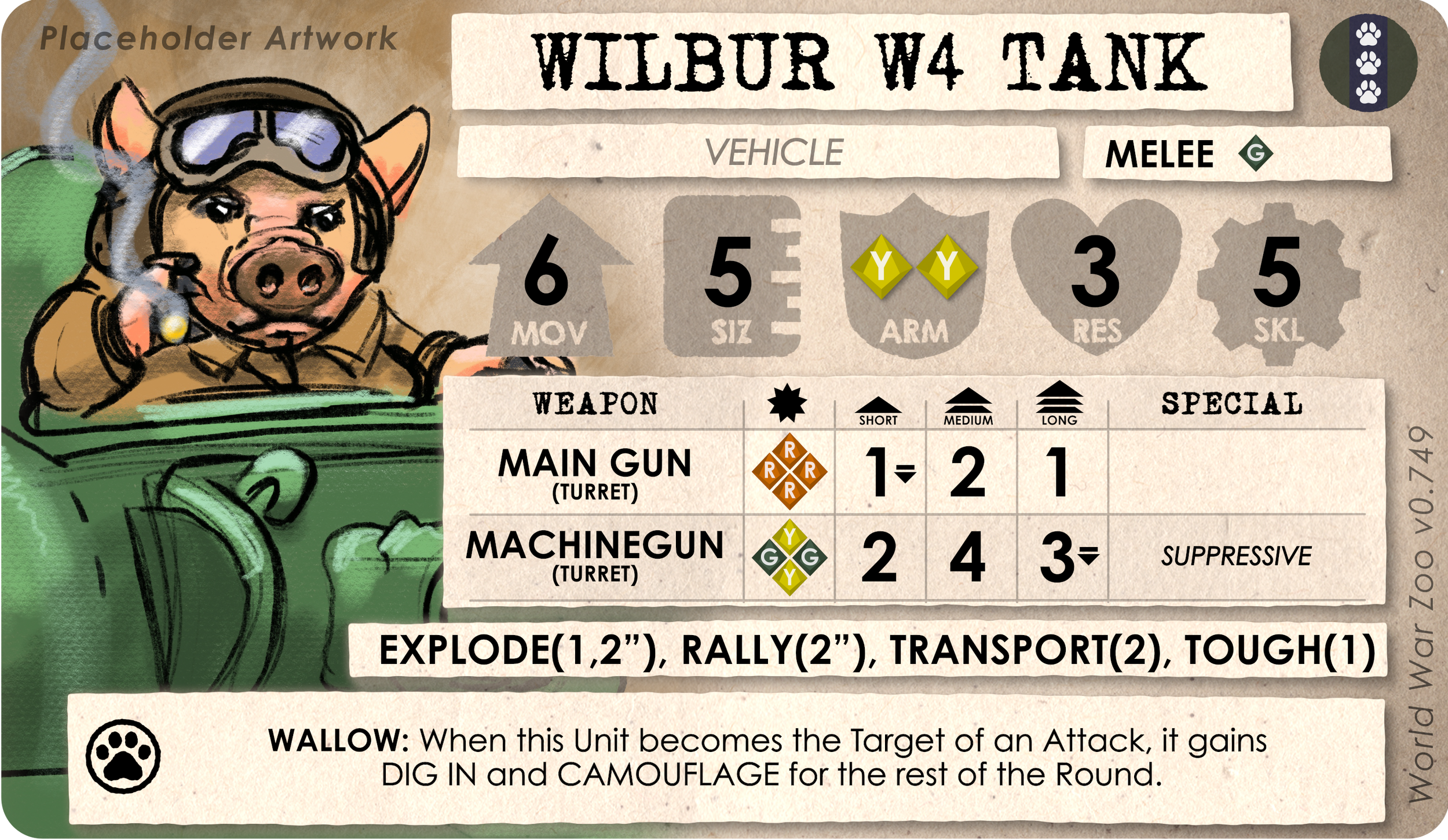
The Wilbur Tank has the RALLY(3”) Ability, giving Friendly Units within 3” of it (inclusive of itself) Advantage on Skill Checks.
Advantage and Disadvantage aren’t only about attacking though. Sometimes a unit will be required to make a Skill Check when it attempts to enter Difficult Terrain. Units benefitting from RALLY(X”) do make this check with Advantage, as do units with the TRACK Ability. Units which suffer Critical Hits and/or are wounded by weapons with Suppressive(X) must make a Suppression Check, which is also a form of Skill Check and which likewise benefits from RALLY(X”) as well as the FEARLESS Ability and from being in COVER. Non-Attack Skill Checks are always just a single die roll/re-roll and don’t benefit from an added die from Multi-Advantage.