
GAME CONCEPTS: ARMY BUILDING
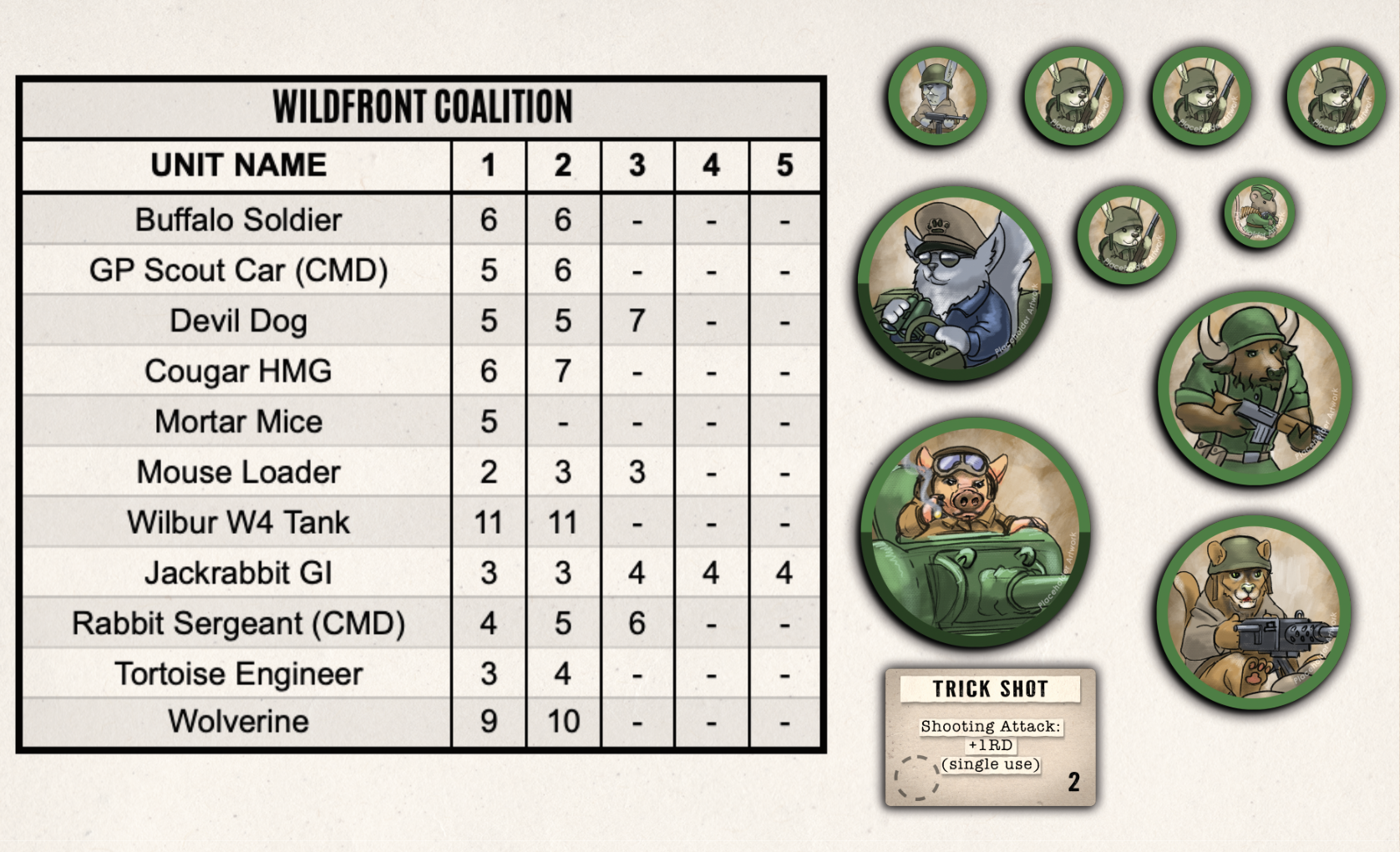
Building an Army in World War Zoo involves a handful of cards, models, and some simple mental math (note that token illustrations are placeholders while official art is being produced)
Force building is an integral aspect of many miniature wargames, and the ability to customize an army with your favorite units and field a unique and personalized squad is a huge draw… but it can be a daunting process for beginners, and even enfranchised players may find it challenging to continuously keep up with unit cost changes and meta shifts.
World War Zoo aims to bring the “fun” parts of army building while avoiding many of the typical pitfalls that come alongside point costs and list customizability. To this end, we’ve embraced a few core ideas about how armies are built.
First, list building should be able to happen extemporaneously. There’s no need to prep your army far in advance or use a list building app (though we plan to offer one in the future). The unit costs are simple enough that you can add up the values of an entire force in your head - its especially easy to do a quick list for the smaller Firefight sized game, which only requires 25 points of units. So if a spontaneous game comes up, you can build a list for yourself or a friend in just a few minutes.
Second, there should be a minimal number of restrictions on the composition of an army that you can bring to the table. No “unlocks” where you need to take one kind of unit to take another and no “force org” charts that involve required distributions of unit types. The only requirements for an army aside from the points cost and quantity limit of each unit type (and ensuring that all units are from the same faction) is that it must have at least one unit with the COMMAND classification among your forces (which factors into achieving certain Mission objectives and gaining “Priority” at the beginning of the game) and that it can have no more than 5 points worth of Upgrade Cards (which will be described below).
Third, lists shouldn’t need to be customized for specific Missions or matchups. While players certainly have the option to play special scenarios with specific force compositions based on either historical battles or narrative designs, the typical game setup of random Mission Cards encourages players to build a balanced force to be ready for any eventuality. All armies have the pieces they need to accomplish all possible Missions, so you won’t ever find yourself with the “wrong” force, and the ability to omit Missions from the lineup when playing the Battle sized game mode allows for an element of strategy in tipping the odds in favor of your fighting style.
Finally, players should be encouraged to bring a wide variety of unit types to the game, rather than spamming the “meta” choice. This is accomplished through a unique method of having point costs that are variable rather than constant.
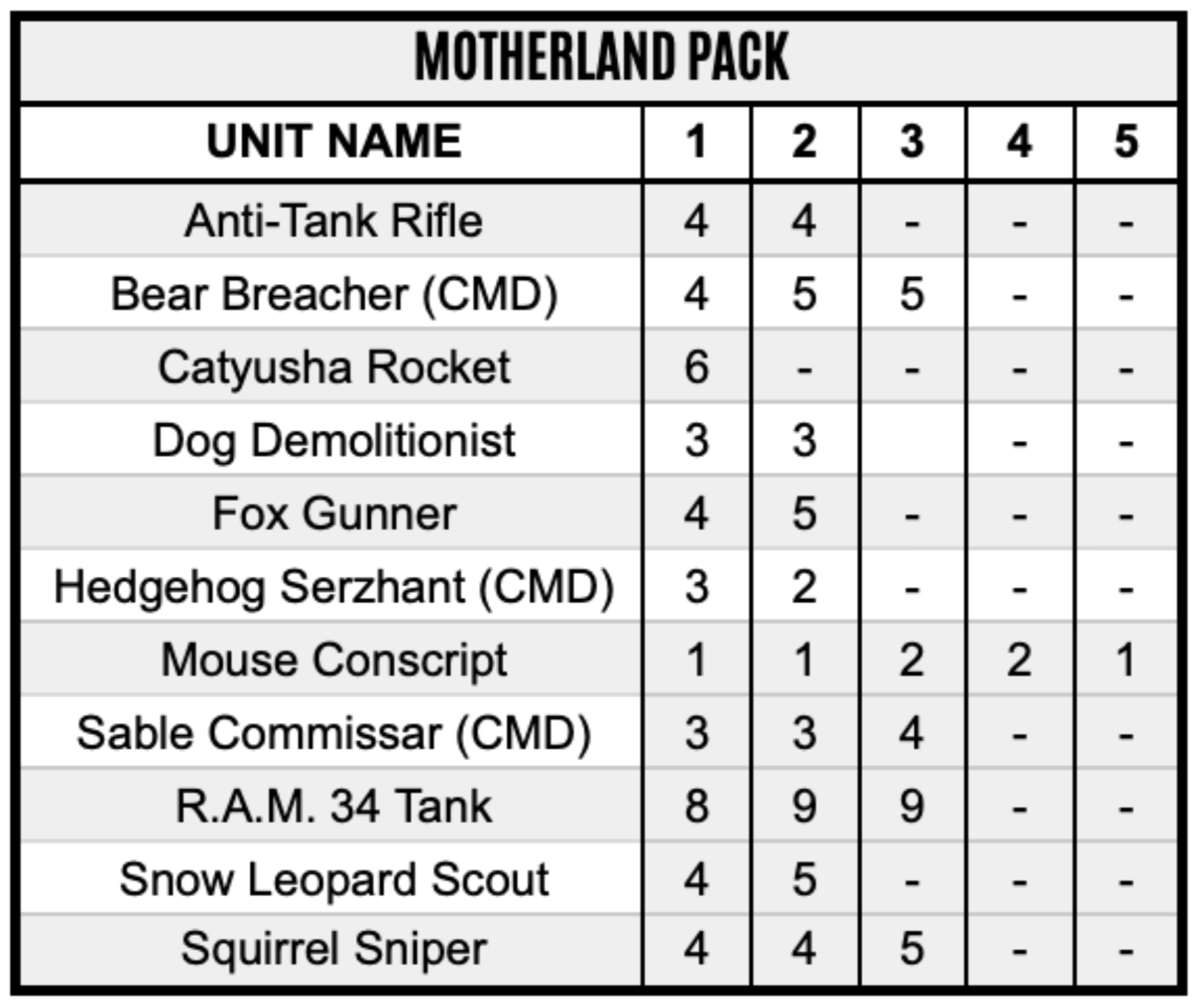
Note that while most units increase in point cost with each successive copy taken, sometimes (such as in the instance of the 5th Mouse Conscript) sees the cost decrease.
VARIABLE POINT COSTS
Note that the Unit Chart shows not a single flat unit cost, but instead a DIFFERENT cost for each successive copy of a unit, up to the maximum of 5. In many cases, this cost increases the more of a given unit is added to the Army. While many units do have a hard cap of less than 5, a player might still be incentivized to simply take the maximum number of a unit they identify as superior to others on the basis of its cost. Many games run into this problem but may have a difficult time tweaking point costs without swinging the pendulum too far in the opposite direction. This is especially of concern in a game like World War Zoo with its emphasis on keeping numerical unit costs very low for the sake of the aforementioned mental math in list building, such that a change of even 1 point in unit cost could make a big difference. Rather than simply enacting draconian restrictions on unit quantity, the game allows for multiple copies of certain powerful units if a player is so inclined, but subtly dissuades unit spamming by ticking up the cost until they compare less favorably with other options. In this manner, you can still bring multiple copies of a unit because you enjoy the model or play style, but it won’t be from feeling obligated for the sake of competitiveness.
Point cost changes are not linear, and in some instances remain the same with successive selections or even DECREASE in cost, leading to some interesting choices of whether to take that one additional copy of a unit at a rebate. This allows for multiple design “levers” to finesse units in spite of the low numerical costs, and allows us more control over de-tuning strong units without making them un-playably expensive.
You may note that the unit costs do not actually appear on the cards. We’ve chosen to keep all unit costs separate. Those who have played card-centric miniatures games in the past will know that when points costs change from what is on the original cards, players who haven’t kept up with those changes can become confused (and potentially field illegal lists), and updates require cards to be re-issued and potentially re-purchased by the consumer to stay up-to-date. To avoid this, we plan to keep a separate repository of points costs in perpetuity such that unit cards are more resilient to the natural development that miniatures games undergo over time. The points list for all armies is currently HERE and will eventually be developed into an army list builder in the future for player convenience.
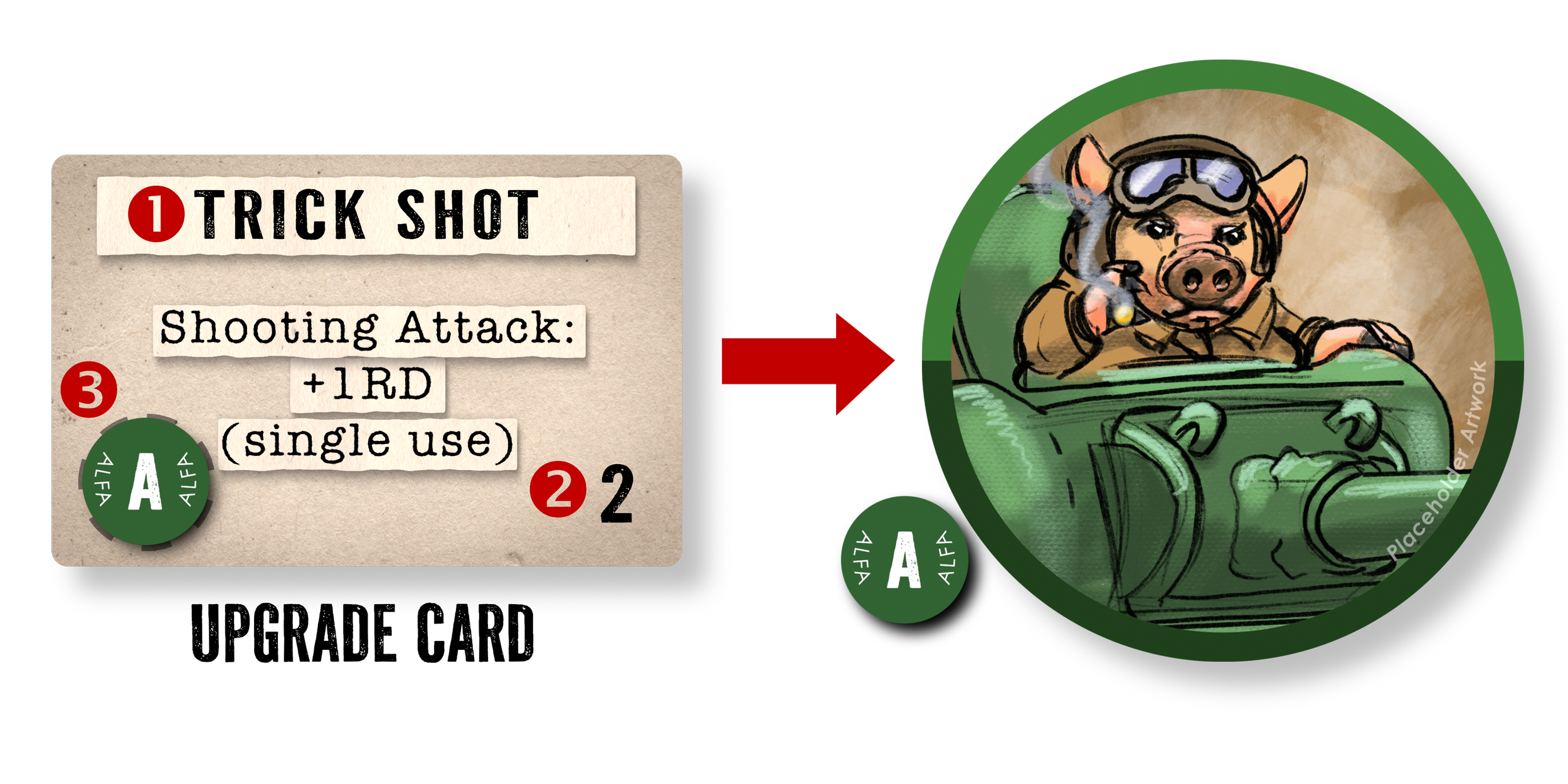
Unit upgrades each have a unique name [1], a point cost [2] and an area for a token to show that the Upgrade is possessed by a specific unit [3] with a matching designation in the case of multiple models of the same type on the table.
UPGRADE CARDS
A common pitfall in list building is having a few points left over after selecting units but without a good way to spend them. This can lead to an extended re-work that involves juggling units in and out in order to try and add up to a the requisite round number. World War Zoo works around this issue by allowing players up to 5 points worth of “Upgrades” for their Army. Although players may build their force with upgrades already in mind, the typical situation in which a player selects an upgrade will be after they have built their list but have a couple of points left and no units of the right cost to spend them on. Upgrades come in point costs of 1, 2, and 3 points. Players are allowed to select one copy apiece of any named upgrade(s), and each unit in their army may carry a maximum of ONE upgrade, which is assigned to them during the list building process. Upgrades can offer significant boons under the right circumstances, but in general they are less powerful than simply taking an an additional equivalently costed unit, so most players will use Upgrades for the aforementioned few points of added value rather than building intentionally around them.
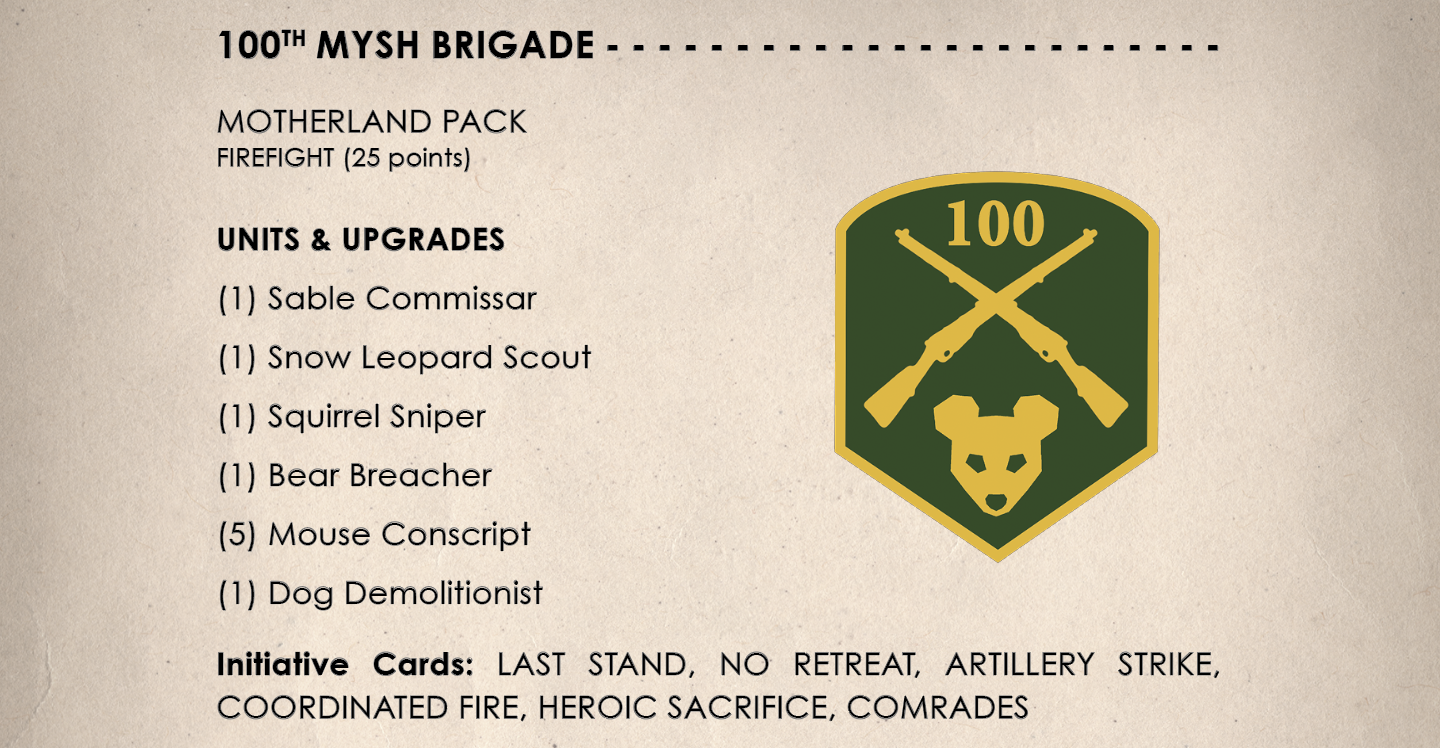
For those not inclined to army building, the rulebook contains several pre-built forces that players can choose in lieu of making their own from scratch. These forces are programmed into the Tabletop Simulator beta of the game as well so they can be easily deployed with a single click.
Next time we’ll talk about the other aspect of army building, which is “Tactics Cards”. These cards give special bonuses to friendly units during the Round that they are played and can synergize with your force’s unit composition to achieve great results when played at just the right time.