
GAME CONCEPTS: DICE
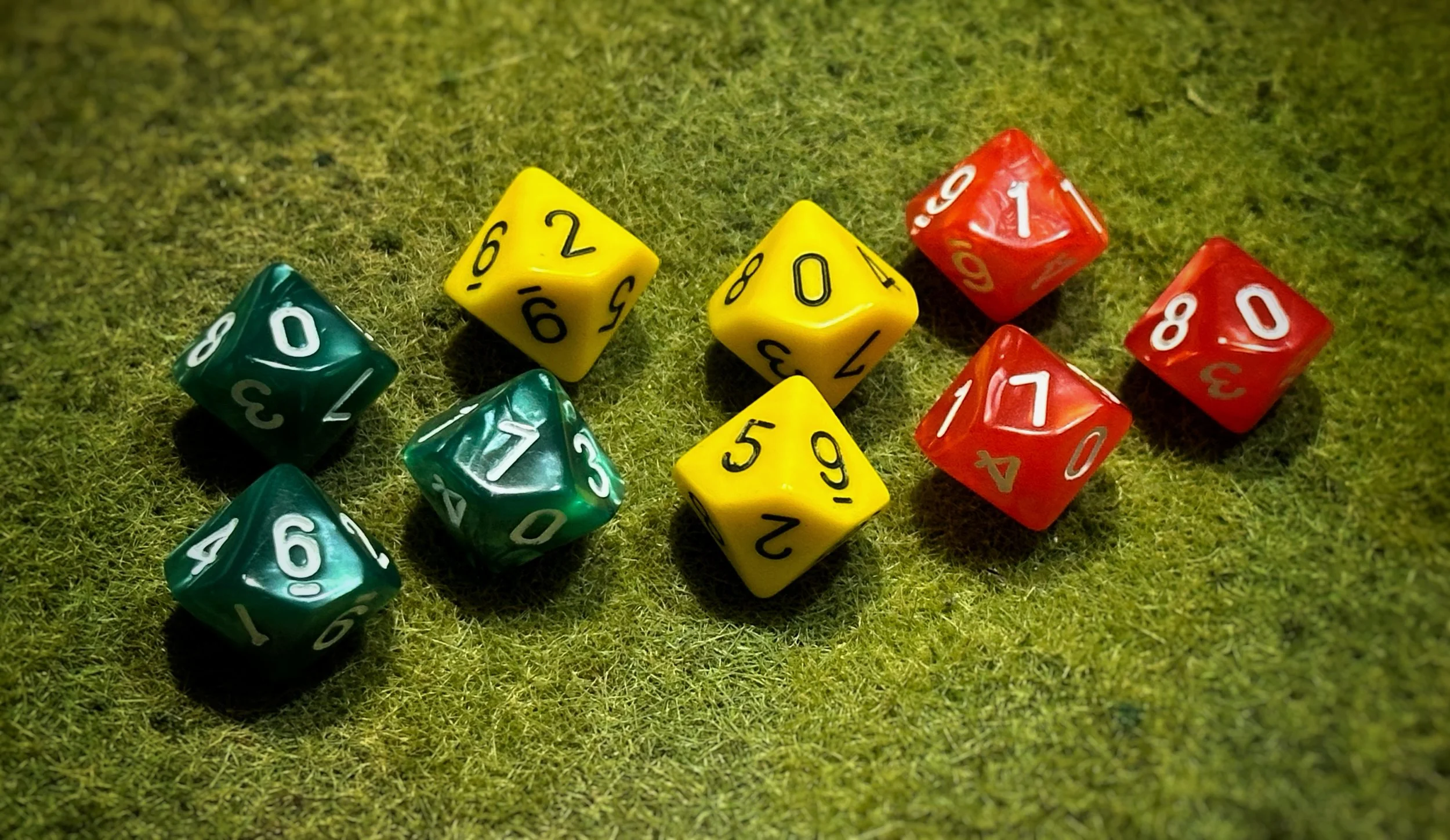
World War Zoo uses 3 different colors of dice to simulate the effects of various weapons
World War Zoo’s dice system developed over a period of time while play testing various methods of establishing odds for attacks and skills. I had been working on a rudimentary D10 system independently a few years back that utilized an odd quirk of possessed by most ten-sided dice… that being the fact that the “10” position on the die is commonly portrayed as simply the number “0”. I’ve always been a fan of games where success results are defined as rolling BELOW a target number rather than above, because it feels more intuitive to me for a high skill level to be represented by a high number rather than a low one that you roll over. When I decided upon the idea that units Size could be a stand-in for to-hit with attacks, this D10 system really came into its own, because it allowed me to logically size the units starting with 1 and working my way up while still making it reasonable to hit such a small unit (with a 20% chance of rolling a 0 or 1 rather than only a 10% chance of rolling a 1).
Over time and various playtests, the system was refined into its current 0-9 form. Rolling at or below the given target number was a success, while a 0, being below everything, was of course an automatic success as well. I had originally eschewed the concept of a true “Critical Hit” effect but incorporated it eventually as a Suppression Check and bonus damage concept to ensure that attacks didn’t always do a predictable amount of damage. Now, for each 0 rolled in an attack, the target takes 2 hits instead of 1. Heavily armored units still benefit from their defenses, with armor dice being able to cancel one hit of the equivalent or lesser die color, and the TOUGH(X) Ability acting as an additional “save” against damage, but if you push enough hits through, it’s still possible for a lowly footstoldier to damage a tank.
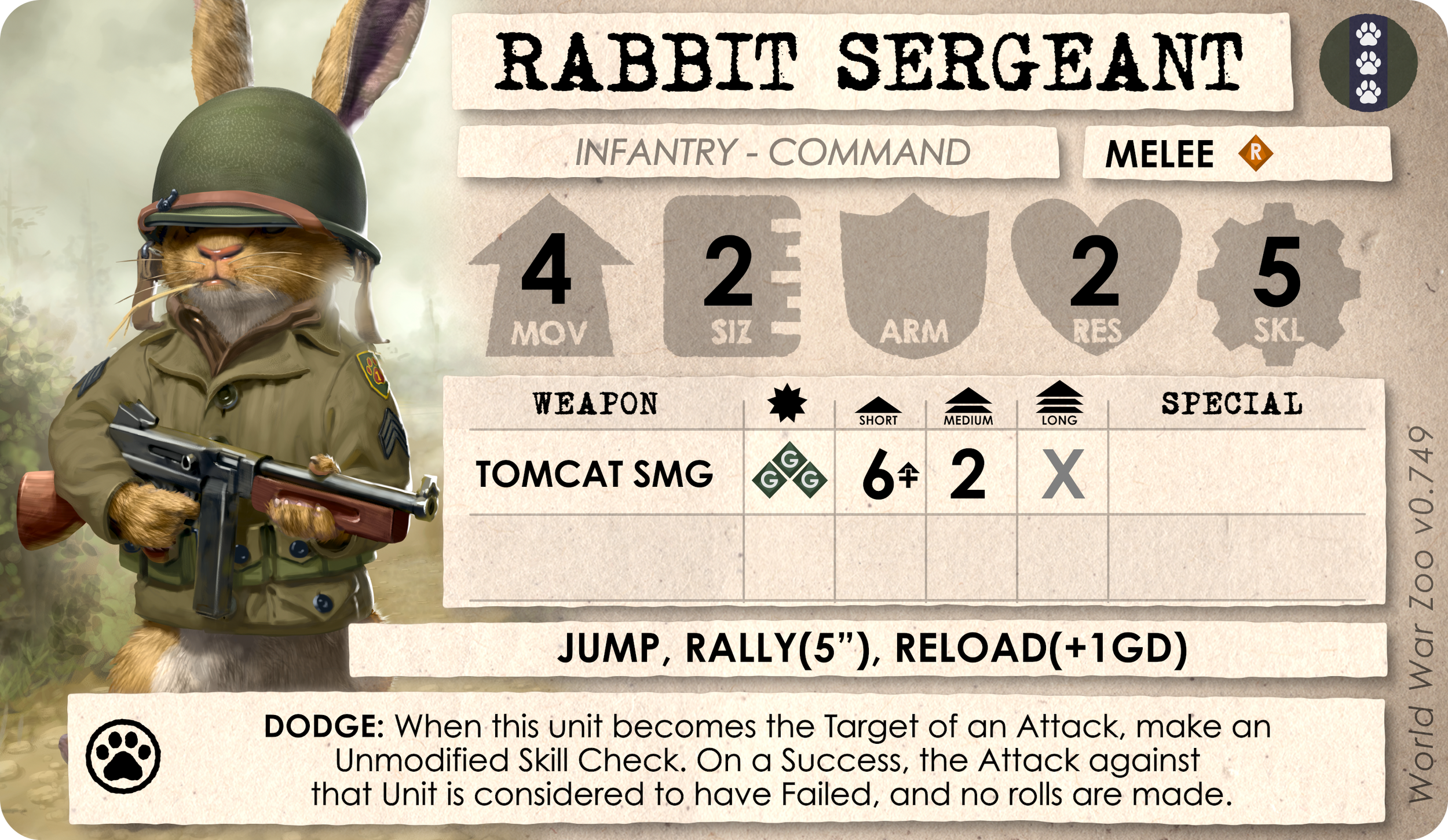
The Sergeant’s “Tomcat” submachine gun fires pistol caliber rounds (represented by green dice icons). It performs very well up close but falls off at longer ranges and cannot target anything further than 12” away (with an X in its Long range band)
Speaking of die color, this was incorporated partway through development as well as a way to avoid the need for independent armor piercing style calculations, with the added nuance of allowing some units dice pools on attacks to consist of multiple colors of dice. Originally its as just green dice for normal attacks and red dice for “Armor Piercing” attacks, but eventually I inserted another dice type into the mix. Now, Green Dice (GD) roughly represent pistol and intermediate calibers, with Yellow Dice (YD) leaning into heavier full sized rifle cartridges up to heavy machine guns, and Red Dice (RD) reflecting high explosives, anti-tank, and armor piercing type attacks. The upside of the multi-dice system here is that it allows for a balance between total possible damage output, likelihood of scoring multiple hits, and how easily block-able the dice are. A Red Die of armor, for example, can block any type of hit (Red, Yellow, or Green) but could be overwhelmed by multiple Green Dice from a single attack, since it can still only block a single die at a time. Likewise, weapons like the Wildfront’s Peltguard Rifle (a stand-in for the venerable M1 Garand) utilizes 3GD for its attacks even though it represents a full-sized rifle cartridge, rather than the 1GD+1YD of some of the other rifles, because this can mathematically create the result of a higher rate of fire and still push damage through on units that might otherwise require Yellow dice to wound. This keeps play smooth and only minimally math-y while still allowing for a wide variety of weapon types. It also allows big units like tanks to feel relatively strong while still being technically killable by infantry if you put enough damage on them - bringing the right weapon for the job is important, but as a casual skirmish type game, I wanted to make sure list building didn’t require a “gear check” of needing anti-tank weapons in order to be competitive.
I adapted a system of range bands similar to my favorite miniatures game “Infinity” but again, wanted to minimize the amount of math involved. Instead of having various mods of +/- against some kind of a shooting skill, each range band had a fixed to-hit number based on the weapon, with the option to use either that number OR the targeted unit’s Size as the to-hit (whichever one was better). Ultimately the idea was re-worded such that the to-hit numbers for each weapon are the default number that needed to be rolled, but you can always REPLACE the to-hit with a unit’s Size.
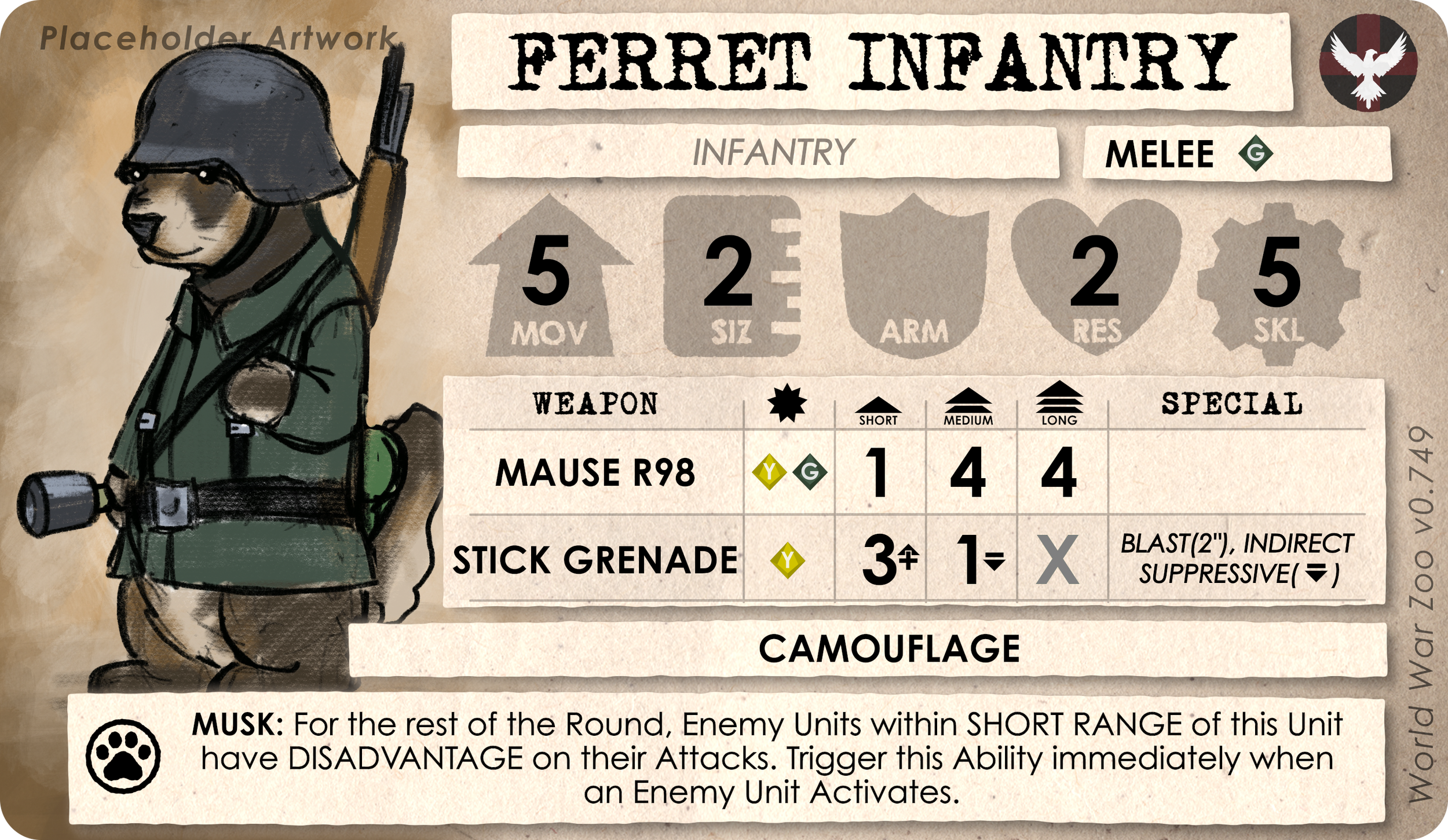
The Ferret’s “Mause” rifle has a 50% chance of hitting at medium range, but it’s less reliable if the target gets too close. Nonetheless, for larger targets, it can still use the Target’s size in place of the native to-hit.
Most weapons in the game are around 4 to-hit in their most optimal range band, which, with die faces of 0-9 is a 50% success chance. Some weapons receive large bonuses (usually specialized short-range weapons like submachine guns) and can get up to 6 or higher to hit under optimal circumstances. Likewise, at poor range bands, a weapon might get as low as a 1 to-hit (with an X meaning that the weapon simply cannot be fired at a given range). This means that, especially when targeting the game’s smallest creatures, you really want to be shooting at your weapon’s optimal range in order to have a good chance of hitting them. The flip side is that the largest units in the game, Size 5 and 6 Vehicles, can be hit at more or less any range with the same to-hit number. Vehicles depend on their Armor and TOUGH(X) Ability, more than their ability to avoid hits, in order to prevent damage. Weapons designed for attacking vehicles also tend to have very low native to-hits at all ranges (with the intent that you will always be replacing the to-hit with a large target’s Size). This naturally discourages the use of such weapons against non-vehicle units without the game resorting to additional specific rules penalizing, say, firing a tank’s main gun at a lowly infantry.
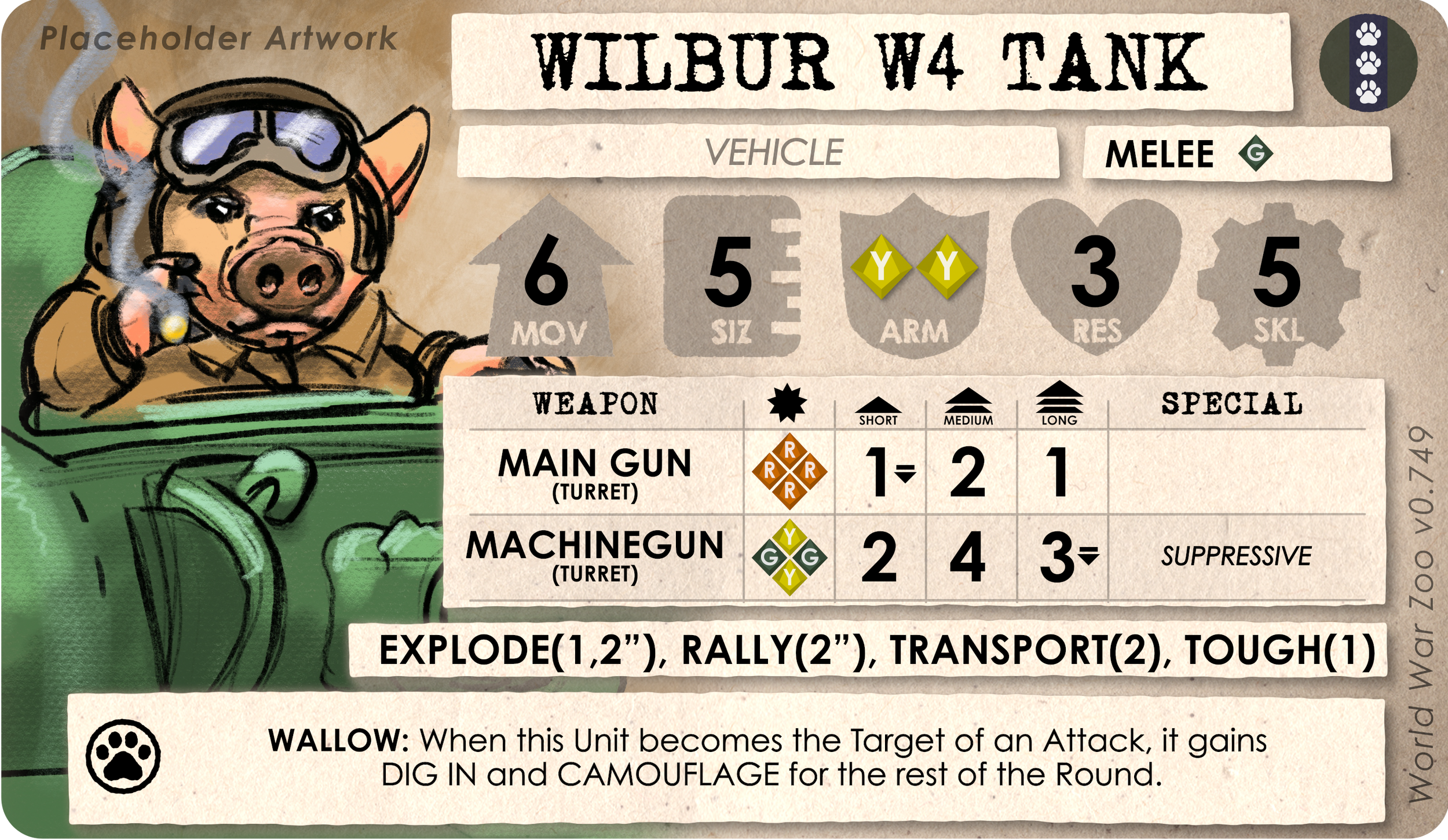
The Wilbur’s main gun has a harder time hitting small targets than its machine gun, but because the types of enemies that it will be using red dice on tend to be larger anyways, it will substitute those units’ sizes for its attack rolls and save the machine gun’s better native to-hit for smaller infantry.
If range ONLY affected the default to-hit, you might end up with a lot of units, particularly when targeting larger opponents where Size becomes the default to-hit, not really feeling any difference between closer and longer range shots. While hitting a big target in the kinds of short range engagements that World War Zoo simulates shouldn’t be excessively difficult anyways, there’s another factor that comes into play affected by range bands (among other things). Regardless of whether you utilize a weapon’s range band as the to-hit or the unit’s size, you might be subject to Advantage/Disadvantage, a fun re-rolls mechanic that will be our topic for discussion next time…