
WORLD WAR ZOO WANTS TO BE YOUR (SECOND) FAVORITE GAME
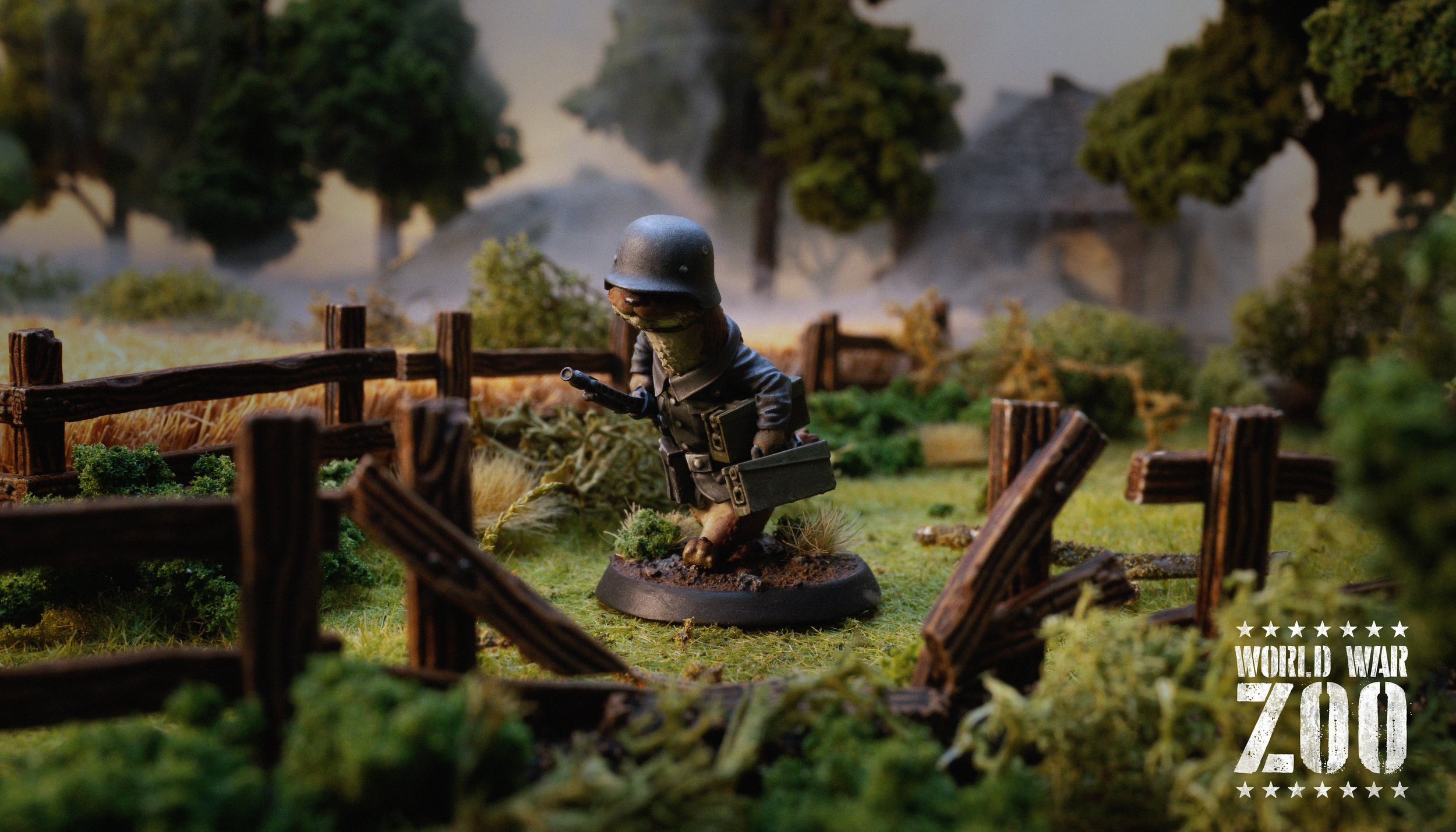
An Ironclaw Ferret Gunner darts between cover on the outskirts of a farm south of Bärenfels (date unknown, colorized)
I’ve been playing miniature wargames in some form or another for about 30 years. During that time, I’ve purchased countless miniatures, sourcebooks, game aids, and hobby supplies. I’ve built terrain out foam and cardboard and 3d printed probably 1000+ models. I’ve designed my own tokens and maps and my own custom scenarios. I Iove the hobby aspect of miniature games and I love reading the rules and the lore. I also love PLAYING miniature games, although this aspect for me is often the most difficult part to actually do with regularly.
The beauty of miniatures games is that there’s so many ways to engage with them. Different ways to play, scenarios, factions, play modes, narratives, tournaments. You could spend all of your spare time exploring a single game, and many a game in this hobby space is something that I usually refer to as a LIFESTYLE GAME - a game that wants to be the only game that you play. A Lifestyle Game (as it pertains to miniature wargames specifically) is a game where you wake up in the middle of the night thinking of a new idea for an army and start building a list on your phone in bed. Your next big terrain project which takes days or weeks might be focused on setting up for a single scenario or campaign. You may travel around the country to visit tournaments or other events. Most people only have room in their life for one or maybe two games like this. We try to do more, but if you’re like me, there are more than a few games in your collection that you had the best intentions for, but for which there are minis sat gathering dust and an obsolete rulebook from the last edition propping up a table leg.
A lot of games want to be your next Lifestyle Game. We hear the phrase “Warhammer Killer” thrown around a lot. The reason the game of Warhammer needs to be metaphorically killed is, implicitly, because you don’t have enough time to play both Warhammer AND whatever other game is on offer. You cannot augment your collection, your hobby time, your play… you must replace it. This is an uphill battle for any miniature game, since whatever a person already plays (often it IS one of the Warhammers but it could be something else as well) is something they have a lot of time and sunk cost in.
The explosion of niche skirmish miniatures games in recent years has been a boon to the miniature hobby, due to generally requiring less disciplined painting/building time for smaller model-count armies, but many of these games still require a level of personal investment and effort that puts them into the “Lifestyle” camp for me, and even those that don’t try to occupy your every waking thought may still require things like extensive custom terrain and/or special scenario setups, heavy prep and list building, or may be very focused on campaign play, requiring a regular group and consistently scheduled games. Although these things all present great possibilities and can be a lot of fun, they also can act as impediments to playing. Additionally, giving players a bunch of options for how to engage with the system (including suggesting various scale options for 3d printing), may hypothetically expand the player pool, but at the same time it fractures a small palyer-base into sub-groups. Imagine picking up a niche game, 3d printing it, and painting an army, only to find that the few other players in your area are playing at 12mm rather than 6mm!?
The impetus for World War Zoo came from my desire to remove as many of the sources of friction to getting a game on the table as possible. While the title of this article is tongue-in-cheek, the sentiment behind it is serious: if I were to force you to choose between this brand new game and whatever you’re already playing, I can’t blame you for sticking with what you’re familiar with and invested in. You’ve only got room for one of those games. But if you actually want to play another game sometimes rather than having it languish on the shelf, I think World War Zoo might be what you’re looking for.
I’m going to highlight a few design choices that I’ve made with World War Zoo to reduce friction and encourage play.
LIST BUILDING
List Building is easy enough that it can be done extemporaneously and doesn’t need to be customized for missions or match-ups. We’ve tried to remove a lot of the typical barriers and complexity for making an army. Building a custom force for any game can be a rewarding experience, and I’m not personally a fan of games that simplify it down to purely pre-set warbands, but we also don’t want to penalize people who don’t have the inclination to pour over stats and min/max their squad, so the goal of World War Zoo’s design here is to encourage building for theme and variety over optimization.
RULES & GAME AIDS
Rules complexity is a weird thing. A lot of games claim to have “simple/fast” rules. But this can be very subjective, and a theoretically concise rules system may be underwritten as well, leading to a predominance of corner cases or unclear rules interactions. The thing I look for in games of any kind of weight is what you might call “intuitiveness”. Do the rules in one aspect of the game mirror the others? Do things work way you would expect? Will you remember a rule correctly if you pick up the game again after 6 months of not playing? As much as possible, these concepts were kept in mind while writing World War Zoo.
Likewise, it can be frustrating to see conciseness take precedence over clarity in a rulebook. There are many instances where just a couple more words in a sentence could change a rule from being completely vague to air-tight, removing the need for future errata. I’ve endeavored to make the rulebook as clear as possible, so while it’s not the shortest book out there (currently 100+ pages w/ illustrations in a 6.5x9” format), it’s designed to be read once, with (hopefully) only rare instances where one needs to go back to it for clarifications. And to minimize that return to the rulebook, all of the units in the game are printed with their Special Abilities explained in summary on the back of their unit cards.
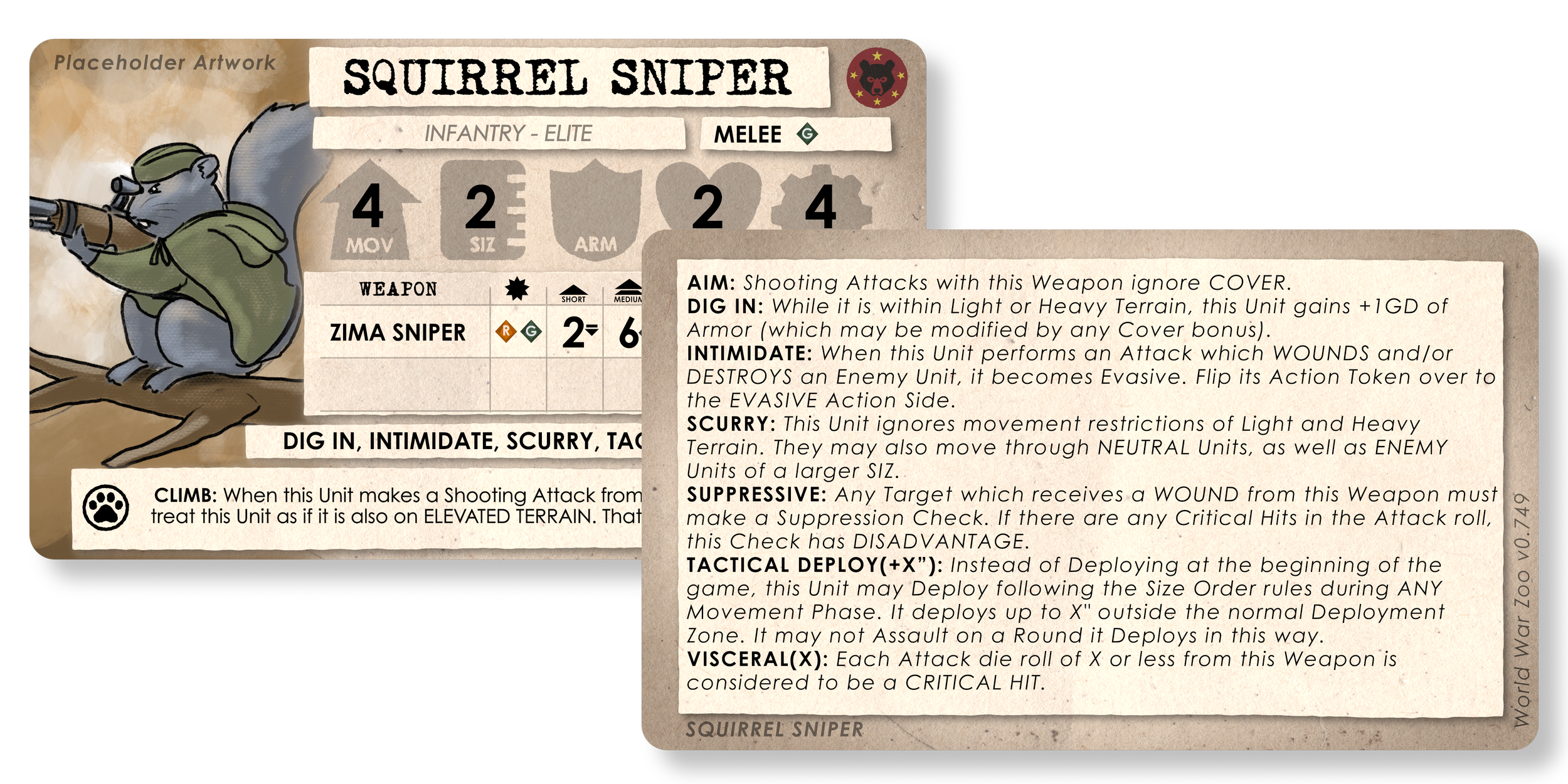
The cardback for each unit features a summary of their Abilities and Weapon Special Traits, for easy reference without needing to page through the rulebook.
To minimize “gotcha” situations where one player doesn’t realize what an opposing unit can do until it’s too late, all units share a set of universal named Abilities, and the specialized Instincts (extra special Abilities which can be performed only once per Round) unique to individual units are also listed in the rulebook, ensuring that you will always have an idea of their capabilities.
MISSIONS & PREP
To ensure that games can get up and running as quickly as possible, the primary way of playing World War Zoo is via the Mission Deck. Once the table is set up, players alternate drawing two cards from the deck and picking one (until 3 Missions are selected) and place any associated Objective Markers/Units on the Battlefield and the game is ready to begin. There are no specific table setups nor custom terrain pieces required, allowing for all Mission types to be enjoyed regardless of what type of Battlefield you construct. Scenarios range from simply killing enemy forces to capturing quadrants of the board, picking up supplies, escorting friendly VIPs, and more. The deck of Mission Cards supports hundreds of possible unique setups, and whether your Missions are kill-y, tactical, or objective-centric, and in what combination, can make a significant difference in your strategy.
As previously mentioned, lists are designed to allow players to make the army of their choice, without the need to take an optimized list for any particular scenario, and the ease of list building means that even if you didn’t do any work ahead of time, you can have an Army put together and a Mission up and running in just a few minutes.
TABLE SETUP
Those who play miniature wargames will know that while the armies are the stars of the show, the amount of work that goes into maintaining a collection of table terrain (not to mention the storage space) can be significant. 28mm scale was chosen for World War Zoo intentionally because many players of both wargames and TTRPGs will already have suitable terrain on hand, and we’ve taken pains to ensure that no specific pieces are required beyond the generic “types” of terrain presented in the rulebook, so that players will be able to play with what they currently have and won’t need to curate a separate collection of terrain specific to World War Zoo.
Additionally, Line of Sight in WWZ is calculated in two dimensions only. This is important because it also allows players who are storage-space-challenged to utilize fully flat terrain setups of paper or chipboard zones for the various terrain types in the game.
No doubt, some players will wish to enhance their experience with complex setups, ruins, and so on, and obviously we welcome creative and complex battlefields. The terrain rules are designed to ensure that complex tables need not complicate the game, though, nor are they necessary to get the full experience.
PLAY TIME
With any miniature game, I feel it’s best to strike a balance between the weight of the game experience and the amount of time it takes to play. Most players don’t want an excessively time consuming game, but they also want a miniature game to feel substantial - especially if part of the play time involves pulling out miniatures and setting up a battlefield with terrain. It’s less of an issue for a game to be long and more problematic for a game to FEEL long.
World War Zoo has been designed not only to be set up quickly, but also to get into the action quickly. You won’t spend early turns poking and prodding and maneuvering. The small maps and close quarters combat means that the action starts immediately.
The standard Battle sized game (experienced on a 36x36” Battlefield) is ideally played in under 2 hours, but for those looking for a faster experience, the Firefight scale game (on a 24x24” Battlefield) can be completed in under 75 minutes.
PAINTING
What model ranges designed for skirmish games lack in scope and scale, they often make up for in complexity. It stands to reason that with hero-type units often being demanding the most complex paint jobs, a smaller game that is FULL of heroes could become a large job on the hobby table… and while complex and beautiful minis are appealing in theory, sitting down with an intricately detailed figure can feel more like work than fun.
The philosophy of World War Zoo is simplicity of design. While experienced hobbyists can always choose to complexity a paint job, kit bash, or otherwise show off fancy tecnhinques, the work to build and paint a table-ready force shouldn’t be demanding. The figures in the game have the right amount of detail where it’s needed, but no more than is necessary, and they strike a balance between realistic “historical” details and slightly cartoon-ified aesthetics. The result is beautiful miniatures that are also easy to paint, ensuring that your hobby time with World War Zoo is stress-free.
Typical forces consist of 7-10 models for a Firefight level game and 11-14 for a Battle scale game, making an entire army a hobby project that can be finished in a weekend.